

THE ELECTORAL COLLEGE EXPLAINED
The importance of the
electoral college
The Electoral College was as
important at the Birth of our Nation as it is now and for much the same reasons.
During the drafting of the Constitution some argued for the President to
be voted on by the Congress while on the other side some wanted to use a popular
vote. The compromise was the
institution of the Electoral College.
At that time, it was feared
that the industrial areas that had a higher population than the more rural areas
would be able to choose the leaders with no say given to the agricultural more
rural area. Today it is much the same.
The most populous areas now reside is the large cities which, in some
cases, have a larger population than some states.
If we were to have a popular vote here is what the map would look like:
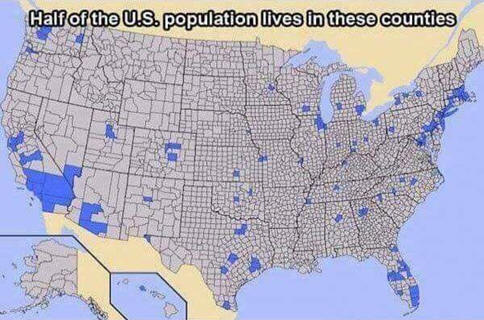
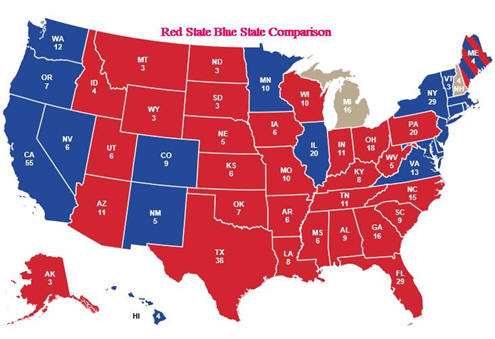
Comparing the two maps above,
although the popular vote can be different from the Electoral College it is
important to see that much of the Country is represented in the College.
There are
currently 538 members of the Electoral College. Each state gets as many electors
as its number of representatives in Congress. So, each state has at least three
electors, because each state has two Senators and at least one member of the
House of Representatives.
In Florida, you can see that
south Florida encompassing Miami-Dade, Palm Beach, the Gulf Coast centering on
the Tampa region and Jacksonville would determine the President.
The other areas of the Nation include such bastions of liberalism as San
Francisco, Los Angeles, San Diego, Boston, New York City, Long Island, Chicago,
Denver…you get the idea. These areas, by population, outnumber the rest of the
Country.
By law, these electors will
gather in their respective state capitals on Dec. 19 for the second stage of the
process — officially casting their votes.
How Does the Electoral
College Work?
The College is run by two
employees of the
Federal Register. The selection of
a President is a three part process.
It begins on Election day where, as in the primaries, voters choose their
Electors. Then the State’s
Governors certify the tally and fill out certificates which are sent to the
Federal Register in Washington. The
final step - on the first Monday after the second
Wednesday in December (December 19, 2016), the electors meet in their respective
States to cast their votes for President and Vice President of the United
States.
Are the
Electors Bound?
The U.S. Supreme Court has
held that the Constitution does not require that Electors be completely free to
act as they choose and therefore, political parties may extract pledges from
electors to vote for the parties' nominees. Some state laws provide that
so-called "faithless Electors" may be subject to fines or may be disqualified
for casting an invalid vote and be replaced by a substitute elector. (National
Archives Administration) As with the Primaries, Electors are generally chosen
from their leadership positions in their political parties or as a recognition
for years of loyal service to the party.
The 12th amendment
states in part:
“The Electors
shall meet in their respective states, and vote by ballot for President and
Vice-President, one of whom, at least, shall not be an inhabitant of the same
state with themselves; they shall name in their ballots the person voted for as
President, and in distinct ballots the person voted for as Vice-President, and
they shall make distinct lists of all persons voted for as President, and of all
persons voted for as Vice-President, and of the number of votes for each, which
lists they shall sign and certify, and transmit sealed to the seat of the
government of the United States, directed to the President of the Senate; The
President of the Senate shall, in the presence of the Senate and House of
Representatives, open all the certificates and the votes shall then be
counted;--The person having the greatest number of votes for President, shall be
the President, if such number be a majority of the whole number of Electors
appointed…”
In short the Electoral
College allows the residents of small states to have an equal voice in the
governing of the Nation. It takes
the iron fist from the large cities and distributes the power equally among all
the states and cities.
There are movements to change
the College. They have failed in
the past due mostly to the fact it takes a Constitutional Amendment to do so.
By the count of the Federal Register there have been at least 700
attempts to modify or eliminate the College.
Since it requires a Constitutional Amendment all have failed.
Por to this election 44 Presidents had been elected only 4 have seen the
Candidate win the popular vote and lose the Electoral College.
Other than this election the most recent was “George W. Bush edged out Al
Gore 271-266 despite Gore winning some 537,000 more popular votes nationwide.
The other electoral-popular vote mismatches came in when1876 Samuel Tilden won
the popular vote but lost the election when Rutherford B. Hayes and 1888
Benjamin Harrison and Grover Cleveland; in all four instances the Democratic
nominee ended up the loser. (In the 1824 election, which was contested between
rival factions of the same party, Andrew Jackson won a plurality of the popular
and electoral vote, but because he was short of an Electoral College majority
the election was thrown to the House of Representatives, which chose runner-up
John Quincy Adams.)” (Pew Research)
With all this being said
Congratulations to Donald Trump who is now our Electoral College victor.